
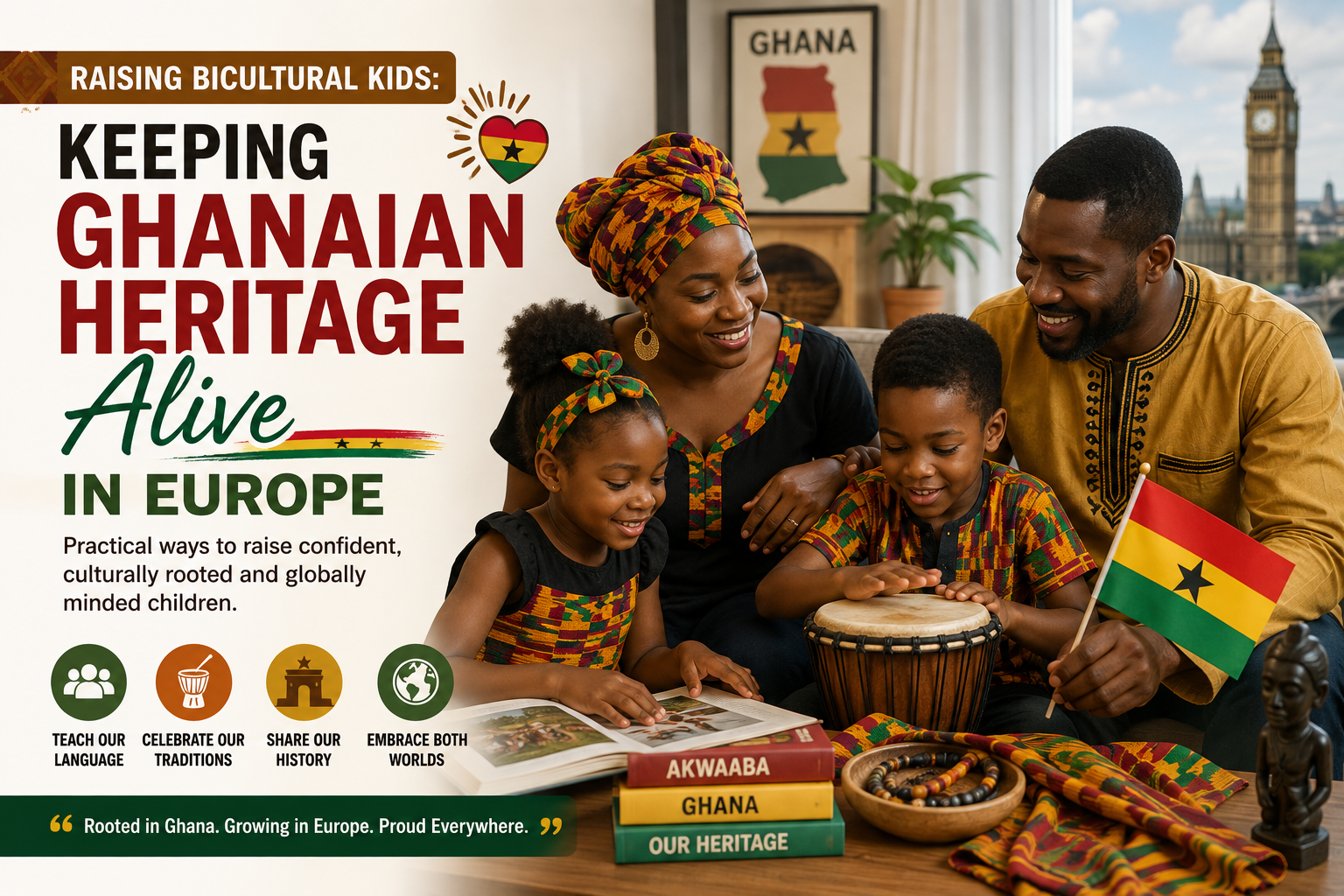
Raising children who feel connected to both their European upbringing and their Ghanaian roots takes intention. Here’s how diaspora families are keeping heritage alive across generations.
For many Ghanaian parents raising children in Europe, there’s a quiet worry that sits in the background: will my children grow up feeling Ghanaian at all? Language, food, music, and stories don’t pass down automatically the way they might if the whole extended family lived in the same neighborhood back home. But diaspora families across Europe are finding it’s entirely possible, it just takes intention.
Speak Twi, Ga, Ewe, or your mother tongue at home, consistently. Children absorb language far more easily than adults, but only with consistent exposure. Even mixing languages within the same conversation helps more than defaulting entirely to the local language.
Cook together, not just for them. Involving children in preparing jollof, waakye, or banku turns food from something they simply eat into something they understand and can eventually recreate themselves.
Celebrate Ghanaian holidays visibly. Independence Day, Homowo, or even smaller family traditions become memorable when children see them celebrated with the same enthusiasm as European holidays around them.
Connect them to other diaspora kids. Growing up as “the only one” in a friend group can be isolating. GDUE’s community events are as much for children as for adults giving kids a peer group that shares their dual identity.
Take them home when you can. Nothing replaces an actual visit to Ghana. Extended family, familiar sounds, and a felt sense of belonging that no story or video call fully captures.
Raising bicultural children isn’t about choosing one identity over another. It’s about giving them the tools to move confidently between both. That’s a gift that lasts a lifetime, and one GDUE is proud to support through our cultural programming across Europe.